
TL;DR: If you’ve been looking to level up from a Kubernetes user to a Kubernetes extender, there’s a free, open-source course that will teach you how to build production-ready operators from scratch using Kubebuilder.
Why Learn Kubernetes Operators?
Kubernetes has become the de facto standard for container orchestration, but managing complex applications on it can be challenging. Enter operators — the secret weapon that transforms you from someone who uses Kubernetes to someone who extends it.
Operators encode human operational knowledge into software. They watch your custom resources and automatically handle the nitty-gritty: deployments, scaling, backups, failover, and recovery. Instead of writing runbooks, you write reconciliation loops. Instead of manual intervention, you get self-healing infrastructure.
The problem? Learning to build operators has a steep learning curve. The documentation is scattered, examples are either too simple or too complex, and there’s a lot of tribal knowledge that isn’t written down anywhere.
Introducing the Building Kubernetes Operators Course
The Building Kubernetes Operators Course is a comprehensive, hands-on program designed to take you from understanding Kubernetes internals to deploying production-ready operators. And the best part? It’s completely free and open-source under the MIT License.
What you’ll get:
- 🎯 8 structured modules covering everything from fundamentals to advanced patterns
- ⏱️ 40-50 hours of focused content (roughly 8 weeks at a comfortable pace)
- 🛠️ Hands-on labs with working solutions for every lesson
- 📊 Visual learning with Mermaid diagrams explaining complex architectures
- 🚀 Real operators you can actually use — not just toy examples
The Learning Path
The course is thoughtfully structured to build your knowledge progressively:
Module 1: Kubernetes Architecture Deep Dive
Before you can extend Kubernetes, you need to understand it. You’ll explore the control plane components, API machinery, and the controller pattern that powers everything. By the end, you’ll create your first Custom Resource Definition (CRD).
Module 2: Introduction to Operators
Time to meet Kubebuilder and build your first “Hello World” operator. You’ll set up your development environment, understand project structure, and run an operator locally.
Module 3: Building Custom Controllers
This is where it gets real. You’ll learn controller-runtime, design APIs properly, and implement robust reconciliation logic. The course walks you through building a complete PostgreSQL operator.
Module 4: Advanced Reconciliation Patterns
Dive into the patterns that separate amateur operators from production-grade ones: conditions and status management, finalizers for cleanup, watching related resources, and indexing for performance.
Module 5: Webhooks and Admission Control
Learn to intercept and validate or mutate resources before they’re persisted. Essential for enforcing policies and setting intelligent defaults.
Module 6: Testing and Debugging
An operator without tests is a liability. You’ll learn unit testing with envtest, integration testing strategies, and how to instrument your operators for observability.
Module 7: Production Considerations
Package your operator with Helm, implement proper RBAC, configure leader election for high availability, and optimize for performance at scale.
Module 8: Advanced Topics
Multi-tenancy, operator composition, stateful application management, and patterns from real-world operators like the Postgres Operator and etcd Operator.
What Sets This Course Apart
1. Complete Working Examples
This isn’t just theory. The course includes complete, working operators you can reference:
- A Hello World Operator for learning the basics
- A full Postgres Operator demonstrating production patterns
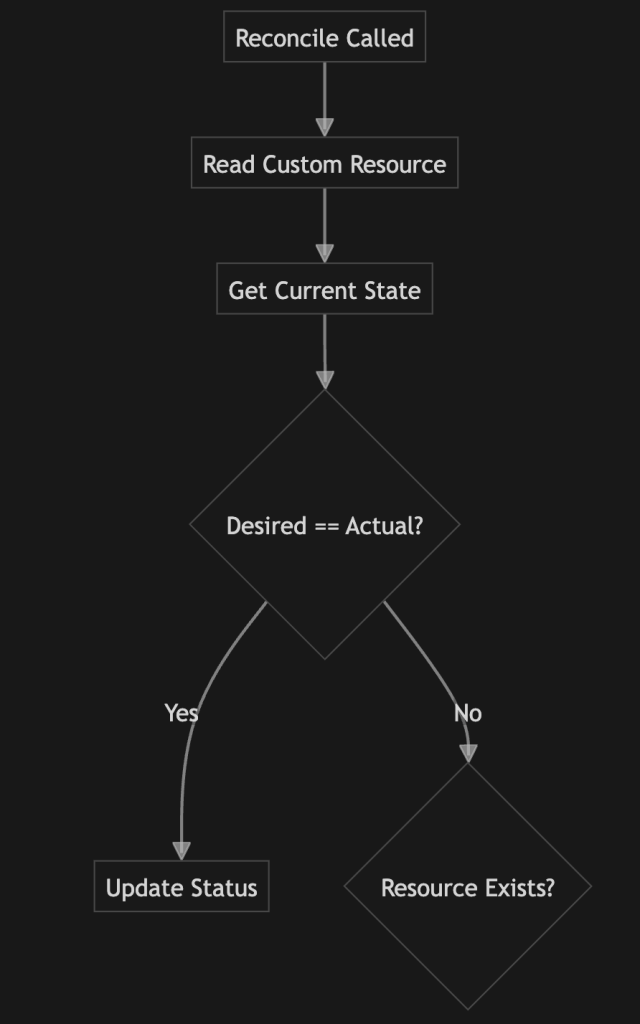
2. Visual Architecture Diagrams
Complex concepts like reconciliation loops and owner references are illustrated with clear diagrams:
3. Progressive Complexity
You start with kubectl cluster-info and end with multi-tenant operators handling stateful workloads with backup/restore functionality. Every step builds on the last.
4. Solutions Included
Every lab has complete, working solutions. When you’re stuck, you can peek. When you’re done, you can compare. No “exercise left to the reader” frustration.
Prerequisites
The course is designed for intermediate to advanced developers:
- ✅ Basic Kubernetes knowledge (pods, deployments, services)
- ✅ Go programming fundamentals
- ✅ Understanding of containerization
- ✅ Familiarity with kubectl
Getting Started
The course makes setup easy with provided scripts:
# Clone the repository
git clone https://github.com/piyushjajoo/k8s-operators-course.git
cd k8s-operators-course
# Set up development environment
./scripts/setup-dev-environment.sh
# Create a local kind cluster
./scripts/setup-kind-cluster.sh
Then just start with Module 1 and work your way through.
Who Should Take This Course?
- Platform Engineers who want to encode operational knowledge into code
- SREs looking to automate day-2 operations
- Backend Developers moving into cloud-native infrastructure
- DevOps Engineers wanting to build self-healing systems
- Kubernetes Enthusiasts ready to go beyond kubectl
Community and Contributions
The course is actively maintained and welcomes contributions:
- Found a bug or typo? Open an issue
- Have an idea for new content? Submit a feature request
- Built an operator after completing the course? Share it!
You can connect with the author Piyush Jajoo on LinkedIn to share your completed projects and get feedback.
Final Thoughts
Kubernetes operators represent the next evolution in how we manage complex applications. They’re the difference between manually scaling databases at 3 AM and sleeping soundly while your operator handles it automatically.
This course gives you everything you need to build production-ready operators — not in theory, but in practice. And at the price of free, there’s nothing stopping you from starting today.
Ready to become a Kubernetes operator developer?
This course is licensed under MIT — use it, share it, build upon it. Happy reconciling! 🎉
 Platformwale
Leave a comment